Infinite Craft Blog — Essays on Recipes & the Browser Game
Not guides. Not recipe lists. This is where I write about what the Infinite Craft game actually is once you stop trying to beat it.
Eight essays about the combining engine, the way players drift through Infinite Craft recipes, and the parts of the Infinite Craft browser experience that keep pulling people back after they have already built Life and already figured out that Pirate plus Pirate equals Pirate Ship.
🎯
Who this blog is for
You have already played the game. You have already found at least one recipe on your own. You have probably also read a guide somewhere and felt like it missed the point. These essays are for players who want to think about Infinite Craft, not just follow chains. If you are brand new and need to learn controls, the how to play guide is the better starting point.
Essay 01 — On language
It is not really about crafting
📖 5 min read🏷️ Language🎯 Engine
The word "crafting" implies materials. You take wood and nails, you follow a plan, you end up with a chair. That is not what happens when you play Infinite Craft. There is no plan. There are no materials. You drag one word onto another word and something new pops out, and sometimes the result is obvious and sometimes the result is a small linguistic joke that you either laugh at or miss entirely.
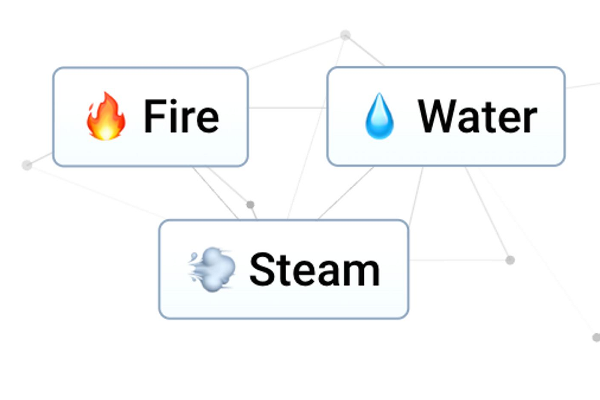
What the Infinite Craft browser engine actually does is guess at meaning. It takes two labels — Water and Fire — and asks what those two ideas would produce if they were forced together. Steam is the easy answer. But the game is not limited to easy answers. Water and Lava gives Stone. Lava and Lava gives something else entirely. The engine is not running a lookup table. It is reading your pair the way a person would read a crossword clue, and then committing to whatever comes to mind first.
🗣️ When the engine surprises you
Every player eventually hits a combination that makes no literal sense. Pirate plus Pirate equals Pirate Ship, then Pirate plus Pirate Ship equals Captain. Nobody would design that on purpose. The engine just followed the association the way a person would.
That is why so many Infinite Craft recipes feel like they were made by someone who was half-asleep. Water and Lava, for example, is not the logical answer — it is Stone, which is what you would get if you thought about the two for half a second and then said the first thing that came to mind. Nobody would sit down and design a tree where the second step is "the person in charge of the thing you just made." But that is exactly the shape the game produces, over and over, because the engine is following associations the way a human brain follows associations — loosely, playfully, and without caring about the logic.
The best way to understand Infinite Craft is to stop thinking of it as a game about elements and start thinking of it as a game about the way words pull on each other.
Once you notice that, the recipes stop being mysterious. How to make Gojo in Infinite Craft is GO + OJ not because it makes any kind of sense as a character recipe, but because a person reading those two letters side by side would see the joke. That is the whole engine. It is a very long, very patient rhyme.
The practical implication is that when you are stuck, you should not think about what is logical. You should think about what sounds right, or what wordplay is being set up, or what the two elements suggest together even if neither of them contains it. That is exactly how the engine reasons, and it is why how to make 67 in Infinite Craft is reachable only through an awkward numeric chain — nothing poetic produces a two-digit number, so the game falls back on pure arithmetic instead.
Essay 02 — On logic
The five patterns behind every Infinite Craft recipe
📖 7 min read🏷️ Engine🎯 Prediction
After a few hundred combinations, you start to notice that the results are not random. They come from a small set of rules. Not rules the game tells you about — rules it just obeys, the way the engine internally weighs one outcome over another. Here are the five that show up most often. Once you spot them, you can predict results before you try the pair.
01
The literal combination
Two elements whose meanings stack cleanly produce the obvious result. Water + Fire = Steam. Earth + Earth = Mountain. No cleverness. These are the combinations the game gives you on purpose to teach the rhythm.
02
The subtraction
When two elements share a core idea, the game sometimes strips that idea out and hands you what remains. Pirate + Pirate Ship = Captain works because the ship is the shared part, and the captain is the residue left over.
03
The category lift
Some pairs rise a level of abstraction. Plant + Plant = Tree is not just more plant. It is a specific larger version. The engine likes to promote concepts into their iconic forms when the pair suggests it.
04
The pun
Wordplay takes over when nothing literal fits. Ban + Life = Banana is not a combination of meanings — it is a combination of sounds. This is where the recipes stop being predictable and start being funny.
05
The collision
Sometimes the engine just picks a third thing that both inputs could plausibly lead to, without either of them containing it. Life + Mars = Alien. Life is not alien, Mars is not alien, but the pair points in that direction hard enough for the engine to commit.
🧩 Patterns in the wild
Look at a long chain on your canvas and try to identify which of the five patterns each step used. You will find that the literal combination dominates the early game, then subtraction and puns take over once you start building abstract concepts.
If you watch for these five patterns, the game stops feeling arbitrary. It becomes a kind of conversation. You propose a pair. The engine proposes a direction. And when you get a result that does not fit any of the five — that is where First Discoveries live. Those are the combinations the engine itself has never been asked before, and it makes something up on the spot.
Essay 03 — On libraries
Reading the shape of your library
📖 5 min read🏷️ Library🎯 Play style
Your sidebar is not just a list. It is a map. After a long session, the categories of elements you have created tell you exactly which branches of the Infinite Craft game you have been exploring, and which ones you have been quietly avoiding. Most players have no idea which category they have been neglecting until they actually look.
The table below is a rough breakdown of what the categories mean. If one column is empty, that branch is where your next session should start. The categories are not official — the game does not label them — but they are how most long-term players mentally organise the space.
Category
Signature elements
What it says about your play
Nature
Plant, Tree, River
You have been building foundations. Good start, but a slow pace.
Life
Human, Man, Woman
You got past the first wall. The character branch is now open to you.
Technology
Engine, Computer, Internet
You went for the shortcuts. Smart — this unlocks the most combinations.
Space
Planet, Star, Galaxy
You are chasing scale rather than detail. Big-picture player.
Mythology
Zeus, Dragon, Angel
You like flavour over mechanics. Rare, and usually fun.
Anime
Naruto, Goku, Luffy
You came to Infinite Craft for a specific fan target. Very common.
📚 A mixed library
A library with a healthy balance across all six categories is rare. Most players lean hard into two or three. That is not a problem — it just means your next session should deliberately target the categories you have been ignoring. The Infinite Craft recipes hub shows what each category unlocks.
None of these columns are "better" than the others. A library that is heavy on mythology and light on technology is not worse than one that leans the other way. It just means the two players will have very different sessions the next time they open the game. If you have never made Planet in Infinite Craft, your space column is empty — and that entire branch is one combination away from being unlocked. If you have never tried Roblox in Infinite Craft, your tech column is thinner than you think.
Essay 04 — On drifting
Two hours in the Infinite Craft game without a plan
📖 5 min read🏷️ Session🎯 Drift
I played a session recently where I never picked a target. I opened the game, looked at the four starting elements, and let the combinations go wherever they wanted. Here is what happened, roughly in order, without editing for how it sounds.
Started with Water and Fire. Steam. Obvious. Then Steam and Earth. Mud. Then Mud and Fire. Brick. Now I have three elements I did not plan for and no idea what they are for.
Went sideways. Earth and Wind gave Dust. Dust and Earth gave Planet. I had forgotten Planet was this easy. Sat there for a second and then made Star from Planet plus Planet. Galaxy from Star plus Star.
Somewhere in the middle I made a mistake. Two cards on the canvas had similar names and I dragged the wrong one onto the wrong one. The result was a nonsense element I had never seen. Turned out to be a First Discovery. I did not even know I had made one until I checked the tab.
Followed that thread for a while. The discovery combined with almost everything I tried, which is the opposite of what you expect. Weird ingredients make weird results, and weird results combine more freely than obvious ones.
At the end, I realized I had spent two hours and never once used the search bar, never opened a guide, never looked anything up. I had no idea what I was doing the entire time and it was the most fun I have had in the game.
The lesson: Infinite Craft rewards drift. Chasing a target is efficient. Drifting is better. If you only ever play to reach the next milestone, you miss the parts of the engine that only show up when you are not looking for anything specific. If you are brand new, drifting too early can feel aimless — the how to play guide gives you the basics to drift productively. But once you have those basics down, drift.
Next time you open the game, try this: do not start with a plan. Pick two elements and see where they take you. If you get bored, pick two more. The tips & tricks guide has strategies for players who want to be efficient, but sometimes efficiency is the wrong goal. Efficiency gets you to a target. Drift gets you to a discovery.
Essay 05 — On shortcuts
Why Infinite Craft shortcuts feel like cheating
📖 5 min read🏷️ Shortcuts🎯 Ethics
Every player eventually finds a combination that feels wrong. Something that should take twelve steps and instead takes two. Something that skips the whole chain you spent an hour on. A common example is how to make Life in Infinite Craft — some players reach it through the seven-step chain, others stumble onto a shortcut and reach it in three. Neither feels like the "real" way.
The instinct is to say it should not work. But the engine accepts it, and once it is in your library it is as real as anything else. Here are the questions people ask when this happens, and what the answers actually are.
Is a shortcut the same as a cheat?
No. Cheating would be editing your save file. A shortcut is just a combination the engine happens to accept. If the game lets you combine A and B to get C, then A + B = C is a real recipe, even if nobody planned it.
Why does the engine allow shortcuts?
Because the engine reads meaning, not progression. If two elements suggest a third strongly enough, the engine commits regardless of how long the "canonical" chain is. It does not know which chains are supposed to be hard.
Should I avoid shortcuts to keep the game fun?
Depends on what you want. If you play for the satisfaction of building a chain, skip the shortcut. If you play to explore what the game can do, use it. The recipes hub shows both routes when they exist.
Do shortcuts affect First Discoveries?
Yes. If you are the first player to try a pair, you get the credit even if the pair is an obvious shortcut. The engine does not care how "obvious" a combination is. It only cares that nobody has tried it before.
The deeper point is that the game does not have an intended experience. There is no designer looking over your shoulder telling you that you used the wrong route. Every combination you find is a valid combination. The only measure is whether you are enjoying yourself. This is also why so many how to make Human in Infinite Craft guides disagree with each other — they are all describing valid routes, and they all feel equally correct to whoever wrote them.
🔗
7
Steps in the canonical Life chain
⚡
3
Steps in the shortest Life shortcut
🎯
2
Ways to make Human
🧩
∞
Undiscovered shortcuts
Essay 06 — On endings
The quiet joy of a dead-end chain in Infinite Craft
📖 5 min read🏷️ Philosophy🎯 Failure
🚪 What a dead-end chain looks like
Six or seven elements along the canvas, all pointing toward one card on the right that has no obvious next combination. Some players delete these immediately. Others let them sit.
Most Infinite Craft sessions end the same way. You reach a target, you take a screenshot, you close the tab. The canvas is covered in elements from a chain you no longer need. You could clear it, but you do not. You leave it there, waiting for the next session, when you will probably clear it anyway.
But there is a specific feeling that happens when a chain does not work out. You build five combinations in a row, each one suggesting the next, and then on step six you try the obvious follow-up and get nothing. Not a wrong result. Nothing at all. The pair refuses to combine. The chain dies.
That moment is underrated. Because it means you found a boundary. You found a spot in the combination space where the engine does not have anything to say. Somewhere in the next hundred million combinations, there is a path that continues from where you stopped. You just have not found it yet.
The best dead-end chains are the ones that feel like they should have an ending. Something about the elements on the canvas suggests a specific result, and then the game refuses to give it to you. You try the reverse order. You try a synonym. You try combining the last element with something obvious from your library. Nothing works. The chain is over.
A dead-end chain is not a failure. It is a door the game has not built yet, waiting for someone to find the right key.
Next time you hit one, do not delete the canvas. Leave it. Come back a few hours later and look at it fresh. The combination that stumped you will sometimes reveal itself immediately. When it does, that is the moment Infinite Craft stops being a recipe book and becomes a game you are actually playing. If it never reveals itself, you have lost nothing — you have a chain worth remembering, and a clear marker of where your library ends.
Essay 07 — On endings that are not endings
Where Infinite Craft 2 would go
📖 6 min read🏷️ Future🎯 Speculation
Every few months, someone searches for Infinite Craft 2 and lands on a fan page that has nothing to offer. There is no sequel. There has been no announcement of one. The browser version is still the browser version, and the mobile apps are still the mobile apps. But the question is worth taking seriously, because the shape of what a sequel could be tells you something about the shape of what the game already is.
Here is what a genuine sequel would need to do differently. Not more elements — the current engine already generates millions of combinations on demand. Not better graphics — the whole point is that it is a word game with cards. Any sequel would have to change the loop itself, and every plausible change runs into the same wall.
🚫
Multiplayer is unlikely
The game has no accounts, no profiles, and no server-side save state. Adding multiplayer would require rebuilding the entire backend, which is not what a browser toy wants to become.
🚫
A campaign mode would break the engine
The engine generates results, it does not enforce them. Any kind of scripted progression would fight against the one thing the game does well.
🚫
Deeper crafting trees already exist
If you want more chains, more branching, and more systems on top of the core loop, try the Little Alchemy alternative or the Doodle God comparison — both already exist as separate browser games.
🚫
An "Infinite Craft 2" would fragment the community
Every recipe on this site, every guide, every essay would need a sibling for the new engine. That is not a small cost for the person maintaining the game.
What actually happens in cases like this — a small browser game that becomes quietly popular — is not a sequel. It is a longer life for the original. The engine gets small updates. New elements get added when someone suggests a good one. The interface gets quality-of-life improvements. The game keeps being the game, just slightly more polished, because the entire appeal is that it does not demand anything from you. A sequel would demand something. That is the opposite of what works here.
So if you came here looking for Infinite Craft 2, the honest answer is that you are not going to find it, and you probably should not want it. What you want is already in the browser tab you had open before you searched. Close this page, go back to it, and make something new. That is what the game is for. If you cannot get back to it — for example, if the page is blocked on your network — the Infinite Craft unblocked guide covers what actually works.
Essay 08 — On returning
Five recipes I keep coming back to
📖 6 min read🏷️ Recipes🎯 Favourites
There are hundreds of thousands of possible combinations in this game. After a long time playing, the ones that stick with you are not the flashiest. They are the ones that reward coming back to them — because each one opens a branch you had forgotten about, or because they are the fastest way to explain to a friend what the game actually does. These are the five I keep landing on.
🧬
Life
The first real milestone in the game. Steam + Venus = Life, and everything downstream depends on it. Seven steps if you build the canonical chain, three if you stumble onto a shortcut. The full chain is one of the most-searched things on the entire site.
Two valid routes — Adam + Eve, or the faster Life + Dust. Both produce the same element. Human is the hinge between biology and society, and every named character recipe in the game eventually traces back to it.
Two steps from the four starting elements. Earth + Wind = Dust, then Dust + Earth = Planet. The whole space branch unlocks from this one element, and it is also the fourth step in the Life chain — so you need it either way.
The longest country chain in the game. Land + Sushi = Japan, and getting to Land and Sushi takes eight combinations. Worth it because Japan opens Manga, Anime, and dozens of character recipes. The Japan guide covers both the Sushi route and the Asia route.
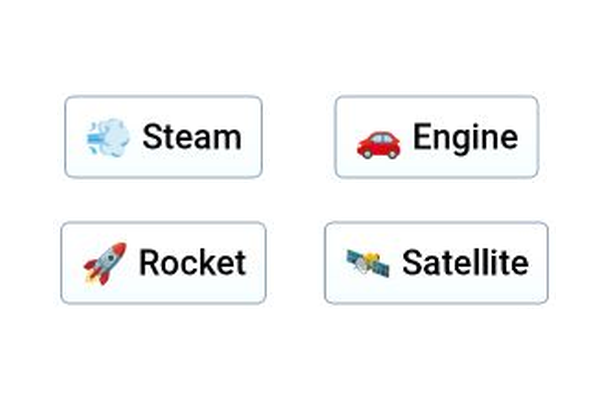
The fastest "advanced" element you can build. Water + Fire = Steam, then Steam + Fire = Engine. Two combinations from the starting elements, and the gateway to every vehicle, every machine, and the entire technology branch.
Notice what these five have in common. None of them are single-purpose. Each one is a hub — the kind of element that keeps showing up later, no matter what you are building. That is the pattern to look for when you are deciding what to chase next. If you want the full list of hubs, the Infinite Craft recipes hub organises everything by category. If you want the ones with the most downstream combinations, the bridge elements section of the tips page is the fastest way in.
Some other targets are worth chasing for different reasons. How to make Money in Infinite Craft is a mid-game discovery that opens the economic branch. How to make Anime in Infinite Craft is the gate to every Japanese pop-culture character. How to make Man in Infinite Craft and Woman are parallel builds that share nine of ten steps. Mud is a two-step recipe that quietly gates the entire Adam and Eve chain. Each one is worth the detour for a different reason, and each one makes the next target easier.
❓ Quick questions about this blog
Short answers to the questions readers send after finishing the essays. If your question is about the game itself rather than the writing here, the full FAQ page covers over twenty-five topics in detail.
Is this the official Infinite Craft blog?
No. This is a fan resource. Everything on this site is written and tested by players, not by the people who make the game. The about page explains how the site works and how recipes get verified.
How often is the blog updated?
Not on a schedule. New essays are added when there is something genuinely worth writing about. The changelog page tracks actual game updates if that is what you are looking for.
Can I use these essays on my own site?
Not in full. You can quote short excerpts with a link back to the page they came from, and you can share the URL freely. The terms of use page covers the specifics.
Where should I start if I just want recipes?
Skip the blog and go straight to the recipes hub. The blog is written for players who already know the game and want to think about what it is doing. Recipes are elsewhere.
📖 Where to go from here
These essays sit alongside the guides, not on top of them. If you want the actual chains — the short, direct recipes for Life, Human, Anime — those live in the guides. This blog is where you come when you want to think about what you have been doing.